
GUIDE / MYXPENG
Earlier UK XPENG G6 V2L: adapter checks, power and safe start/stop
For the earlier UK G6, use a V2L discharge adapter documented as compatible with your exact car and the appliances you plan to power. Its UK handbook specifies 230 V and up to 3.3 kW: unlock the car, keep charge above the selected discharge reserve, connect the compatible adapter and check that the appliance receives power.
This procedure is for the original UK G6 handbook supplied in June 2025, printed pages 54 and 202–203. It is not a rating for every later G6: match your own vehicle and adapter documentation before using another model's power figure.

Check the adapter before you buy or connect it
Ask for the exact adapter model's written G6 compatibility, UK socket/voltage rating, maximum continuous load and start/stop instructions. Check that its lead, socket and protection arrangements suit the intended location. A charging cable is not a V2L discharge adapter, and a connector fitting the port does not establish electrical compatibility.
Use the lower applicable limit from the vehicle, adapter, lead and appliance instructions. The earlier UK G6's 3.3 kW maximum is a total output ceiling, not 3.3 kW for each connected item. Check the appliance's rated input and any starting requirement before connecting; if those are unknown, do not use that appliance for your first test.
Set up one appliance and check power
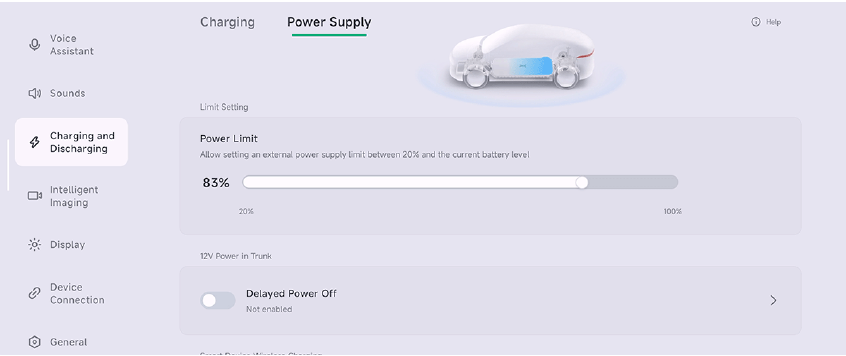
- Park, unlock and check the battery reserve. In the earlier UK G6's Charging and Discharging view, tap Power Limit at the bottom of the vehicle model to set the discharge reserve. Keep enough for the next journey and charging stop. This handbook sets a minimum of 20%; V2L is unavailable below 20%, and power stops when the selected reserve is reached.
- Open the charge-port cover. Beside an earlier UK G6, unlock the car and press the cover's upper-left area. Inspect the compatible adapter, lead and appliance; use one known suitable low-load appliance for the first comparison.
- Follow that adapter's connection instructions. The UK handbook says inserting the discharge plug starts supply when the car is unlocked and battery charge exceeds the supply limit. Do not force a plug that does not seat normally.
- Switch on the appliance and check that it operates normally. On the vehicle's discharging interface, tap Current, Voltage or Power to view its discharge curve. Check the displayed load against the documented limits; a fitted adapter alone does not establish that power is flowing.
- Stop before removing the adapter. Tap End Power Supply on the car, switch off the appliance as its instructions require and confirm supply has stopped. The original UK handbook then says to press and hold the discharge plug's unlock button to remove it. Finish with the port covered.
If it will not supply power or stops
Battery at the chosen reserve: stopping is expected. Leave that reserve in place if you need it for driving; recharge before using more power. The 20% floor is not permission to spend your journey reserve.
No output with charge above the reserve: check that the car is unlocked, the adapter is the correct documented model, the plug is seated and the appliance's own switch is on. End the supply through the normal screen control before inspecting connections or changing the appliance. Compare one suitable known-working appliance within the ratings; do not dismantle the adapter or raise a limit to hide a fault.
A fault message, abnormal supply or repeated stop: end use. Do not keep retrying. Keep the adapter model/rating, appliance input rating, battery level/reserve and exact screen message; ask XPENG and the adapter supplier to check the car/adapter compatibility and the reported discharge fault. Those details distinguish a reserve stop from an adapter or vehicle fault.
How much battery will it use?
Estimate the appliance's energy as watts × hours ÷ 1,000 = kWh. A 100 W appliance running for two hours uses 0.2 kWh at the appliance; the car can use more because supplying it has losses and overhead. This calculation is for planning, not a promised percentage drop or guaranteed runtime. Watch the car's actual battery level and keep the driving reserve you selected.
Evidence reviewed 26 October 2026: original UK G6 handbook, printed 54 and 202–203 (PDF 55 and 203–204). Output, reserve and normal start/stop controls are documented there. Adapter-buying checks, one-appliance comparison and energy arithmetic are editorial checks; no third-party adapter has been certified or recommended here.
Open source